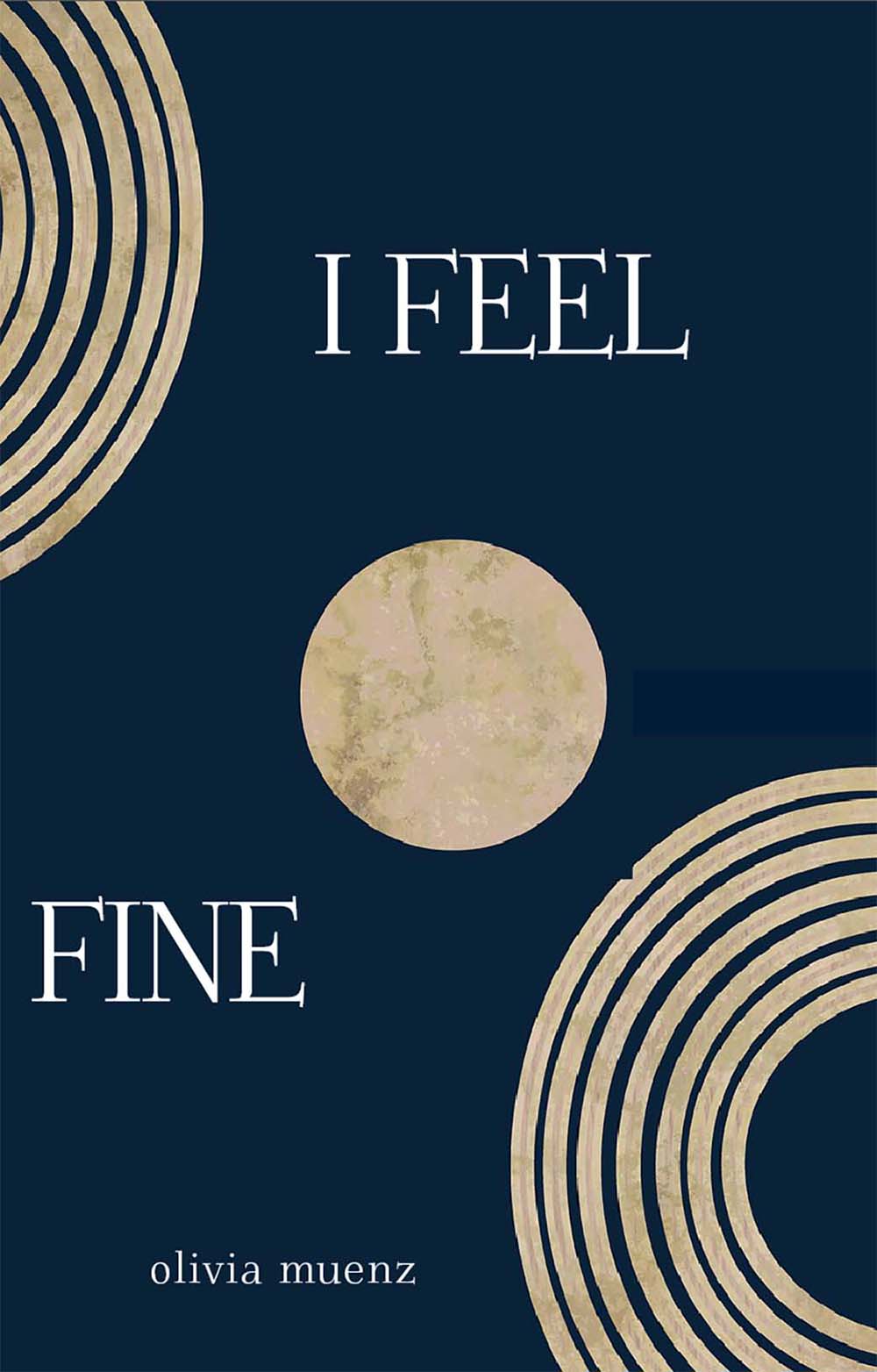
Back when I was an MFA student, a professor in workshop told me that every good poem maintains a “contract” with the reader—that is, it establishes a certain set of terms that need to be fulfilled in order to ensure its success. I have a lot of problems with this approach to poetry. First, it naturalizes legal language, reducing poetry—one of humankind’s most transcendentally untamable creations—into a thing of taxonomic certainty, the insurance plan of New Criticism. But more appropriately for the review at hand, it also posits a stable, monolithic readership: invariably, one that is college-educated, middle- or upper-class, probably English-speaking and American, and—at least for the professor in question—white, male, heterosexual, and able-bodied.
I begin with this anecdote because Olivia Muenz’s I Feel Fine is one of the more ardent critiques of the readerly “contract” I’ve encountered in the past few years, directly challenging the mainstream politics of identarian representation within our contemporary cultural moment. Which is to say: if the neoliberal project often purports to value historically marginalized identities insofar as they are legible and assimilable to a larger capitalist system, Muenz cultivates a complex, unstable affect that resists this kind of digestibility. I Feel Fine clearly asks the reader to approach the text through the lens of disability—Muenz’s bio characterizes her as a disabled writer, and Laura Mullen’s blurb on the back of the book describes it as an “important addition to the field of disability studies.” But at the same time, the first poem of the book begins with an affront to easily consumable forms of identity performance:
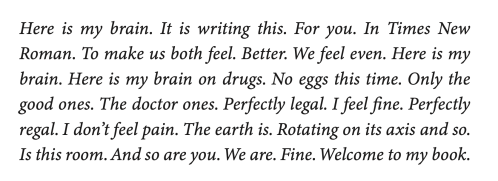
Immediately, Muenz dashes any assumption of individualistic representation we might expect from a title like I Feel Fine. While she may be writing for “us,” the point is not to perform for readers to make them “feel better” about themselves (i.e., “inspiration porn”), but rather, to make us better at feeling. “Welcome to my book,” Muenz writes, but as I Feel Fine progresses, it becomes clear that it is our book, too: “Here is the world. We are in this together. The body pulls. In toward itself and toward all of us.” Through its usage of formal fragmentation—spare, choppy sentences that demand a reconstructive approach on the part of the reader—Muenz averts the gaze away from her own subject position. Instead, she writes in collectivist terms, asking us to consider the violent demands of an ableist society.
On a formal level, I Feel Fine had me thinking about Lyn Hejinian’s famous distinction between “open” and “closed” texts. The “challenging” aspect of this text, however, does not stem from lingual or syntactical density (in the vein of much of the Language writing that Hejinian’s argument originally accompanied). Much like its deceptive title, I Feel Fine is “easy” to read on a surface level—its diction is fairly plain; it appears to emit from a coherent poetic speaker; and while its halting fragments recall Alice Notley’s usage of quotation marks in The Descent of Alette, it’s not hard to figure out what’s happening within individual sentences. Its complexity, however, lies in its wildly inconsistent affect, which is probably my favorite thing about this book: from sentence to sentence, its tone shifts from being glibly inviting towards the reader—e.g., “Welcome to my book,” a line that I find hilarious for some reason—to being cold and outright hostile: “Here I’m giving you an out. I’m giving you an out. Well if you don’t want to take it. That’s not on me.” Later: “Here are my keys. Now get lost.” And later still: “Aren’t you dumb. For listening.” It’s a hard speaker to pin down. Right as I began to feel a sense of control as a reader—thinking, Hey, I get it! It’s a performance, this is funny!—this book would very quickly tell me to fuck off, and I respect it for that: “But I never run out of bits. Do you like my routine.”
Because disability is often not a static identity category, but rather, a condition through which many people move in and out throughout their lives, the formal approaches I describe above—Muenz’s resistance to consumable performance, and her desire to include the reader—feel particularly important. In one of my favorite passages, she gestures towards the precise problem of fetishizing individualism:
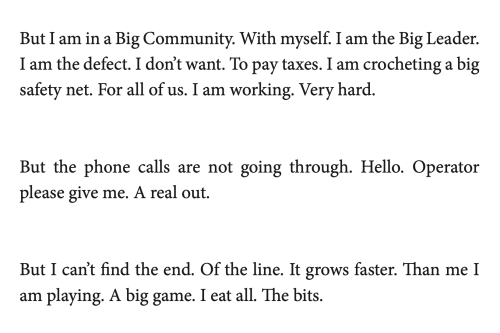
As scholars such as Miranda Joseph have shown, “community” itself is not inimical to capitalism; on the contrary, our system depends upon community to accommodate its own lacks, outsourcing the burdens of care in order to sustain its workforce. (In her argument, Joseph specifically focuses on the nonprofit industrial complex’s parasitical relationship to capitalism. Drop me an email if you don’t have institutional access to Joseph’s book: martymcain@gmail.com.) In the above poem, the slippage of “Big Community” into “myself” gestures towards this precise problematic. What does real community look like? How does one work against a violent system without falling victim to its demands to “just keep working harder”? I don’t have any definitive answers to these questions, and I’m not sure that this book does either, but I find myself lingering on the image of “crocheting a big safety net. For all of us,” and its striking parallels to the “work” of small press poetry. Crocheting—a practice often thought of as idle and ornamental—probably won’t save us on its own. But like poetry, it foregrounds process, initiates contemplation and—perhaps—might serve to create forms of kinship and connectivity not easily consumable to capitalist logics. Muenz is working hard, while also asking us to think critically about what work is. This book makes me incredibly grateful, as a reader and writer, to be working alongside her.
Available for pre-order from Switchback Books.
 Mossy Reviews
Leave a comment